
While it has always moved in circles, 2026 Mumbai Real Estate outlook shows an entirely new pattern from earlier phases of growth.
“Mumbai’s investment story has come full circle, returning to pre-pandemic levels and crossing the USD 1 billion mark for the fourth year in a row.”
Report on Indian Real Estate (Q3 2025) by Cushman & Wakefield.
The narrative is shifting from short-term market movements to long-term urban transformation.
This is no longer just about rising prices or record sales numbers. Infrastructure, capital flows, buyer maturity and land scarcity are collectively reshaping where people choose to live, how they evaluate homes and why certain locations continue to outperform others over decades.
For anyone tracking Mumbai Real Estate closely, 2026 stands out as a year where many of these structural changes begin to take shape.
What we discuss:
- Are buyers confident in Mumbai Real Estate in 2026?
- What is the price per square foot across Mumbai's micromarkets?
- What are the long-term fundamentals in Mumbai Real Estate?
- What's the future of Mumbai Real Estate?
- How is luxury housing in Mumbai Real Estate?
- Does Mumbai Real Estate value community living?
- What's driving Mumbai's redevelopment boom?
- What's the outlook for Mumbai Real Estate?
Mumbai Real Estate 2026: Strong Buyer Confidence
Mumbai’s residential market has demonstrated resilience over the past few years. Even as global economic conditions fluctuated, housing demand in the city remained consistent, particularly in mid-premium and luxury segments.
What stands out is the nature of demand.
Buyers today are significantly more research-driven. Instead of chasing launch-stage discounts or speculative appreciation, they are evaluating:
- Long-term liveability
- Neighbourhood quality and future transformation
- Developer credibility and execution track record
- Rental yield potential and resale liquidity
Mumbai’s continued dominance in national housing sales of exceeding USD 1 billion for 4 years is not accidental. It reflects deep-rooted confidence in the city’s ability to generate stable long-horizon returns supported by constant population inflows, job creation and limited land availability.
Mumbai Real Estate 2026: Price Per Square Foot Across Micromarkets
Mumbai's per-square-foot pricing spans a wide band, from the sea-facing western suburbs to the more affordable outer corridors.
The spread tells its own story. South Mumbai with worli and Mahalaxmi anchors the top of the market on the back of sea-facing inventory and limited fresh supply. Dadar and Santacruz hold a strong mid-premium position on connectivity and social infrastructure.
Powai and Parel sit at a comparable price point despite very different profiles, one lake-facing and institutional, the other transit-led and redevelopment-heavy.
The outer western suburbs, Kandivali, Borivali, Mulund, Malad and Vikhroli, cluster in the ₹32,000 to ₹35,000 range, which is where most of Mumbai’s end-user demand and redevelopment activity is now concentrated.
Pricing Gap Between Adjacent Micromarkets
What makes Mumbai unusual is how sharply price can shift within the same neighbourhood. Cross a railway line or a road, and the number on the price tag moves by thousands per square foot, sometimes lakhs on the total ticket size.
Bandra West carries a sea-facing, cafe-led lifestyle premium over Bandra East, which trades on proximity to the BKC corridor.
Andheri West's Bollywood studios and upscale pockets price ahead of Andheri East's commercial and IT-park belt. Powai's lake views and institutional address price well above neighbouring Chandivali.
Dadar West's old-money addresses like Shivaji Park outprice Dadar East's community-focused housing stock, and Vile Parle West, adjacent to Juhu and popular with business owners, edges ahead of Vile Parle East's more residential, family-lineage character.
This ties directly to the shift already underway across the city: travel time, rather than distance, is becoming the new metric of value.
A two to three kilometre gap between micromarkets can translate into a ₹5,000 to ₹10,000 per square foot difference, driven by connectivity, employer presence and lifestyle offerings.
If you'd like to evaluate projects to understand its unique offerings and pricing, reach out to our team who can help you navigate this chaos!
Mumbai Real Estate 2026: Long-Term Fundamentals
One of the clearest signals of market strength is the extent of institutional investment flowing into Mumbai Real Estate.
Large domestic and global funds tend to flow into cities where long-term demand visibility is high and Mumbai consistently fits that profile.
Net investments exceeding USD 1.2 billion in recent years suggest that investors see Mumbai not as cyclical trade, but a core portfolio market.
This capital is primarily backing:
- High-quality residential assets
- Mixed-use and transit-oriented developments
- Prime commercial and rental-yielding projects
For end-users and individual investors, this institutional backing makes it stable, reducing volatility and reinforcing price steadiness across key micromarkets, making it incredibly attractive.
What Returns Look Like: CAGR and Rental Yield
Price growth in Mumbai has settled into a steadier, more measured rhythm than the speculative cycles of the past.
A Reuters poll of property analysts conducted in early 2026 pegs home price growth across major Indian cities, Mumbai included, at roughly 5 to 7 percent annually over the next three years, a pace consistent with a market that is compounding on fundamentals rather than sentiment.
Rental yield tells a more nuanced story. Mumbai's citywide gross rental yield sits at approximately 3.8 percent, lower than cities like Delhi or Kolkata, largely because capital values have outpaced rents for years. But yield varies meaningfully by micromarket:
- South Mumbai and Malabar Hill: roughly 2 to 3 percent, where capital appreciation, not rental income, is the primary return driver
- Established mid-suburbs like Bandra and Andheri: roughly 3 to 5 percent, a more balanced mix of income and appreciation
- Outer and peripheral corridors like Thane and Navi Mumbai: yields tend to edge higher, though on a smaller capital base
Read together, this is a market that rewards patience. Lower yields in prime micromarkets are offset by stronger long-term capital appreciation, while mid-suburbs and emerging corridors offer a more balanced income-plus-growth profile.
What is the Future of Real Estate in Mumbai?
Perhaps the most significant shift underway is infrastructure. For decades, Mumbai’s Real Estate growth was limited by congestion and limited mobility. Today, that equation is changing, with major infrastructure and redevelopment projects.
Projects like the Coastal Road extension, Mumbai Trans Harbour Link (Atal Setu) and multiple metro corridors are not just easing traffic, they are reshaping mental maps of the city.
Travel time, rather than distance, is becoming the new metric of value. This shift has implications like:
- Central and southern locations are regaining relevance due to faster east-west and north-south connectivity
- Emerging corridors are becoming viable for both end-use and investment
- Well-connected micromarkets are witnessing stronger price resilience or increase
Infrastructure-led price appreciation tends to be gradual but resilient, often playing out over a 7-15 year horizon, making this phase in 2026 particularly exciting for long-term buyers. The Mahalaxmi racecourse conversion into a park is a great example of this.
For more updates on the city’s infrastructure and it's impact on real estate, join our WhatsApp community.


Mumbai Real Estate 2026: Luxury Housing
Luxury housing in Mumbai has matured significantly. Earlier, it was often driven by status or exclusivity. Today, it is increasingly shaped by functionality, planning, and sustainability.
Buyers in the premium segment are asking deeper questions:
- How efficient is this layout for the next 20 years?
- Will the building age well?
- Is the neighbourhood future-proof in terms of access and amenities?
- Does the project offer privacy without isolation?
Sea-facing and waterfront homes continue to hold their appeal but their value is now held in place by even more factors: limited supply and lifestyle demand.
Locations such as Worli, Lower Parel, South Mumbai and BKC remain structurally strong because they combine employment access, social infrastructure and aspirational living within limited developable land.
Mumbai Real Estate 2026: Community Living
Another subtle but important shift is the growing preference for quality over quantity. Buyers are no longer impressed by long amenity lists alone. Instead, they value:
- Thoughtfully designed common spaces
- Low-density planning
- Open space and natural light
- Secure and well-managed communities
This change reflects a post-pandemic rejuvenation where homes are expected to support work, rest and recreation within the same environment.
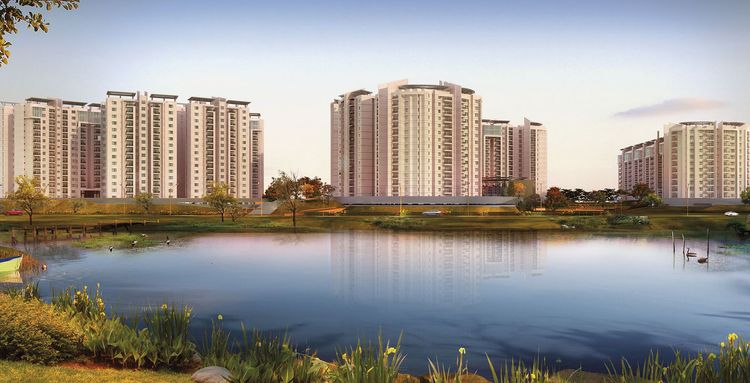
Well-designed gated communities and mixed-use developments are increasingly seen as self-sustaining ecosystems ideal for families.
Mumbai Real Estate 2026: Redevelopment at Scale
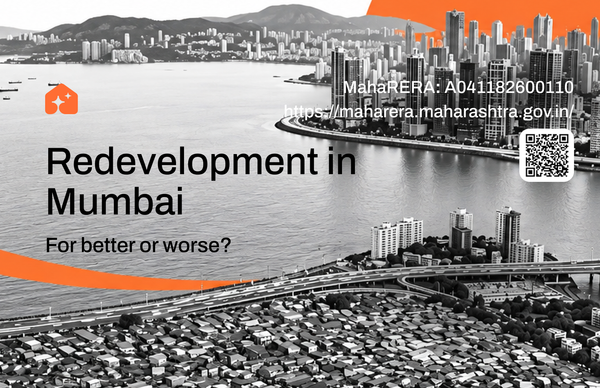
Redevelopment is Mumbai’s answer to a city that cannot expand outward. With Floor Space Index long a constraint for developers, redevelopment projects typically unlock additional or incentive FSI, and the scale of activity since the pandemic has been significant.
Around 910 societies have signed development agreements since post-COVID, opening up roughly 330 acres of potential land area within Mumbai. The activity concentrates mostly in a handful of micromarkets:
Borivali, Andheri and Bandra alone account for an estimated 139 acres of redevelopment activity in the Western Suburbs, against 43 redevelopment agreements across Central and South Mumbai.
Parel stands out for the scale of individual deals rather than count: a ₹364 crore joint development agreement involving Lodha Developers, Sahana Group and Sattva Group, alongside the Sattva Sumera project with an estimated ₹5,500 crore revenue potential.
Beyond the top six, Mulund, Vile Parle, Goregaon and Dadar are also seeing strong redevelopment activity, spanning old housing societies, slum rehabilitation and railway land redevelopment.
Why Some Homeowners Don't Move Back
Redevelopment typically takes 3 to 5 years to complete, and that timeline shapes homeowner behaviour in ways that matter for anyone tracking these micromarkets.
Roughly 10 percent of homeowners ultimately choose not to move back into their redeveloped homes. Some relocate to their hometowns during construction and settle there.
Others discover they prefer more affordable, less congested peripheral areas over central Mumbai, a decision senior citizens in particular are prone to make, drawn by reduced congestion, a slower pace of life, a cleaner environment and a lower cost of living.
The exit pattern happens in two stages. Around 20 to 30 percent of society members choose to sell to the developer and exit at the agreement stage itself, a decision developers often make easier by actively encouraging buyouts.
Of the remaining majority who stay in through construction, around 90 percent do move back once the project is complete.
For Mumbai’s real estate story, this means redevelopment is reshaping not just buildings but the composition of neighbourhoods themselves, as a steady share of long-time residents trade central addresses for affordability and quieter living elsewhere.
What is the Outlook for Real Estate in Mumbai in 2026?
According to a report by Knight Frank, as many as 44,277 apartments worth ₹1.30 lakh crore are expected to enter Mumbai’s real estate market through the redevelopment segment by 2030.
When viewed together, several forces combine in 2026:
- Infrastructure projects moving from planning to impact
- Stable price growth projections
- Maturing buyer preferences
- Upcoming launches
This combination suggests that the coming years may reward early and informed decisions more than reactive buying later down the line in the market cycle.
Final Thoughts
Mumbai has always been a city where real estate decisions carry generational significance. As the market enters its next phase, success will depend less on short-term decisions and more on understanding the city’s long-term direction.
For buyers and investors willing to engage deeply with location dynamics, infrastructure impact and evolving lifestyles, Mumbai in 2026 offers not just opportunity, but clarity.
To have a pulse on the market and get in-depth information on Mumbai Real Estate in 2026, join a community of Mumbai homebuyers and investors with The HomeTrust Collective.
If you'd like to know more about the state of Mumbai real estate today, get on a call with our experts!