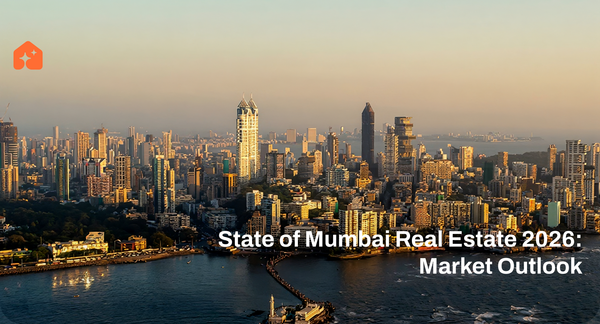
South Mumbai has historically been the business centre of Mumbai, making it the wealthiest urban region in India. Families belonging to law, trade, textile, gold and diamond industries historically formed the residential makeup of this market.
What they are primarily known for are the skyrocketing property prices, which are amongst the highest in the whole country. Real estate transactions in this region have surpassed ₹703Cr for sea-facing duplexes.
Despite all of it, it continues to be popular amongst homebuyers in an aspirational manner. Popular micromarkets like Mahalaxmi and Parel are being reinvented due to social and public infrastructure projects, meaning the eyes are still on South Mumbai.
In this blog, we will analyse why South Mumbai is the way it is by looking at its popularity amongst homebuyers and the recent infrastructure projects shaping it.
Here is what we discuss:
- What is the history of South Mumbai?
- Is South Mumbai’s significance fading?
- How is South Mumbai changing today?
- Why are homebuyers moving to South Mumbai?
- What is the price/sq ft in South Mumbai?
- Why do these micromarkets command a premium?
- What is the infrastructure shaping South Mumbai?
Brief History of South Mumbai
Famous for its Gothic, Victorian and Indo-Saracenic buildings, South Mumbai still carries the stylistic elements that seem stuck in the colonial-era.
South Mumbai, and Mumbai at large, emerged as trade and administrative hubs wherein they built English-style buildings due to it being the centre of their colonial operations. Their efforts to build docks for trade also contributed to their presence in South Mumbai.
Now, it hosts the most affluent people of the country, with infrastructure that cannot be found in most of the country.
Has South Mumbai Become Less Significant?
Many locals believe that it is. While the North with Bandra, Andheri and Powai have “progressed”, South Mumbai appears to be archaic where it almost stands as an entirely different place of its own.
Bombay Rent Control Act of 1947 kept rent low in many areas within South Mumbai, but what ended up happening was that the people who could “breathe life into the city” or contribute to the city’s advancement got priced out because they couldn’t grow at the same pace as the rest of the city.
Buildings began to crumble and remain unmaintained, taking away the charm that it’s famous for.
How is South Mumbai Changing Today?
In an effort to keep up with the progress that the rest of the city was making, especially North Mumbai, certain changes started to prop up. While Marine Drive and Fort might seem stuck in its time, the rest started to grow vertically, as Mumbai eventually has.
Apart from areas restricted by UNESCO or Navy regulations, the rest have started to evolve.
They fall under stringent heritage regulations. UNESCO restrictions and Navy height limitations ensure that redevelopment here cannot alter scale, form, or skyline. Worli, for example, has grown exponentially and now reflects an ultra-modern skyline.
As the city grows, it is forced to change in order to accommodate people. There’s only so long South Mumbai can stay the same before people’s aspirations to live in a modern South Mumbai changes it entirely.
Join our WhatsApp community where Mumbai homebuyers discuss all things Mumbai real estate:


Why are Homebuyers Moving to South Mumbai?
For Ultra-HNIs and NRIs, South Mumbai shows something unique that no other region in the country can replicate. From the calm of Malabar Hill to Marine Drive's iconic Queen's Necklace, luxury and slow-living is embedded into the city.
Major infrastructure projects like the Coastal Road Extension, Mumbai Trans-Harbour Link (MTHL) and Eastern Freeway have dramatically improved accessibility. It is easier than ever to live in a sea-facing heritage apartment with this connectivity.
South Mumbai is the quintessential blend of the old and new. One can enjoy the charm of the past without sacrificing modern conveniences and a lifestyle that reflects the ultra-urban crowd.
In terms of market performance, South Mumbai’s performance in terms of consistent demand and high-ticket prices is unmatched. Lower Parel has been one of the major hotspots seeing high-ticket transactions in the range of 6-15 Crores.
Major Micromarkets & Price Per Square Foot in South Mumbai
Each micromarket in Mumbai contains its unique touch. All of them command really high prices when compared to the rest of the city or even the whole country.
- Worli: ₹1,20,000
- Mahalaxmi: ₹70,000
- Prabhadevi: ₹60,000
- Parel: ₹50,000
- Mahim: ₹45,000
- Matunga: ₹50,000
- Dadar: ₹55,000
Although calculated by carpet area as compared to saleable area in most other cities, these micromarkets command higher price/sq ft and thereby higher ticket prices.
Why Do These Micromarkets Command a Premium?
One of the major things propelling South Mumbai to the forefront is its old charm. With many preserved buildings reflecting old architecture and history, it is a unique experience.
Along with that, the city is built in a way that is future-ready, with wide roads, connectivity and other modernity that makes South Mumbai very attractive when it comes to quality of life.
With cable-stayed bridges and undersea tunnels, this zone is well-suited to deal with congestion and the population, something that a lot of other micromarkets cannot confidently claim.
Such an outpour of investments into bettering South Mumbai shows its true value in Indian and global real estate market, where it is one of the most preferred areas for ultra-HNIs and NRIs.
Infrastructure Shaping South Mumbai
There are a lot of infrastructure projects aiming to improve connectivity across MMR, and South Mumbai also benefits from them.
Here is what is currently operational in terms of South Mumbai’s connectivity:
- Coastal Road: Provides robust connectivity along the coastline and its extension will reinforce its credentials
- Mumbai Metro's Line 3: Provides connectivity across South Mumbai
- Bandra-Worli Sea Link: Connects Western Suburbs to South Mumbai
- Mumbai Suburban Western Line: Connectivity is strong via the Mahalaxmi station
- Eastern Freeway: Proximity to this major road
- Mumbai Trans Harbour Sea Link (MTHL): 21.8 km sea link connecting Sewri to Navi Mumbai International Airport (NMIA) in 20 minutes
Upcoming Infrastructure in South Mumbai:
- Sewri-Worli Elevated Connector
Double-decker elevated bridge at Prabhadevi, linking the Mumbai Trans Harbour Sea Link (MTHL) at Sewri to the Bandra-Worli Sea Link. High-speed corridors for Worli, Prabhadevi, and Dadar.
- Worli Dairy Land Transformation
Complete redevelopment into a vibrant mixed-use district, including Grade-A office towers, premium residences, retail spaces, and green public areas.
- Coastal Road Extension Project
Improves north–south travel and enhances accessibility from Marine Lines to Versova and beyond.
Final Thoughts
South Mumbai’s spacious streets and open spaces makes it a city that lounges, a privilege that many other cities cannot afford. When it comes to advanced infrastructure and space to accommodate their population, South Mumbai has it figured out for the foreseeable future.
With prices anywhere from ₹45,000 - ₹1,20,000, South Mumbai sees a premium in price/sq ft and ticket prices that is quite different from the flow of the rest of the city.
Upcoming infrastructure projects like the Sewri-Worli elevated connector,The Orange Gate tunnel and coastal road extension can further contribute to South Mumbai’s liveability and popularity.
For more such updates on South Mumbai and a close eye on the market, join our WhatsApp community.