Not every IT hub creates a real estate boom.
Some corridors see rents rise, new employers move in and home prices steadily climb. Others get plenty of headlines but little lasting residential demand.
So what separates the two?
We looked at our in-house micromarket CAGR data alongside commercial leasing volumes and employer concentration to identify the Bengaluru corridors where the IT story is translating into a residential one, and five micromarkets stood out.
Here’s what you can expect:
- What makes a micromarket investment-worthy near IT hubs?
- Sarjapur Road: The IT Growth Engine
- Outer Ring Road, East: Bengaluru's Commercial Powerhouse
- Whitefield: The Mature IT Hub
- Bellandur: The High-Growth Corridor
- Hebbal: The Scarcity Play
- Which of these should you choose?
- Does this list have any limitations?
What Makes a Micromarket Investment-Worthy Near IT Hubs?
Residential demand in Bengaluru follows jobs before it follows anything else. Wherever a large employer signs a long lease or a tech park reaches high occupancy, rental demand and resale liquidity tend to follow within a few years.
That means a micromarket with a rising price chart but a thin or ageing employer base carries a different risk than one where a Wipro or a Manyata Tech Park is actively expanding. Looking at CAGR alone misses that distinction.
During a webinar we conducted at the end of 2025, we predicted real estate expansion in 2026 by looking at commercial leasing activity.
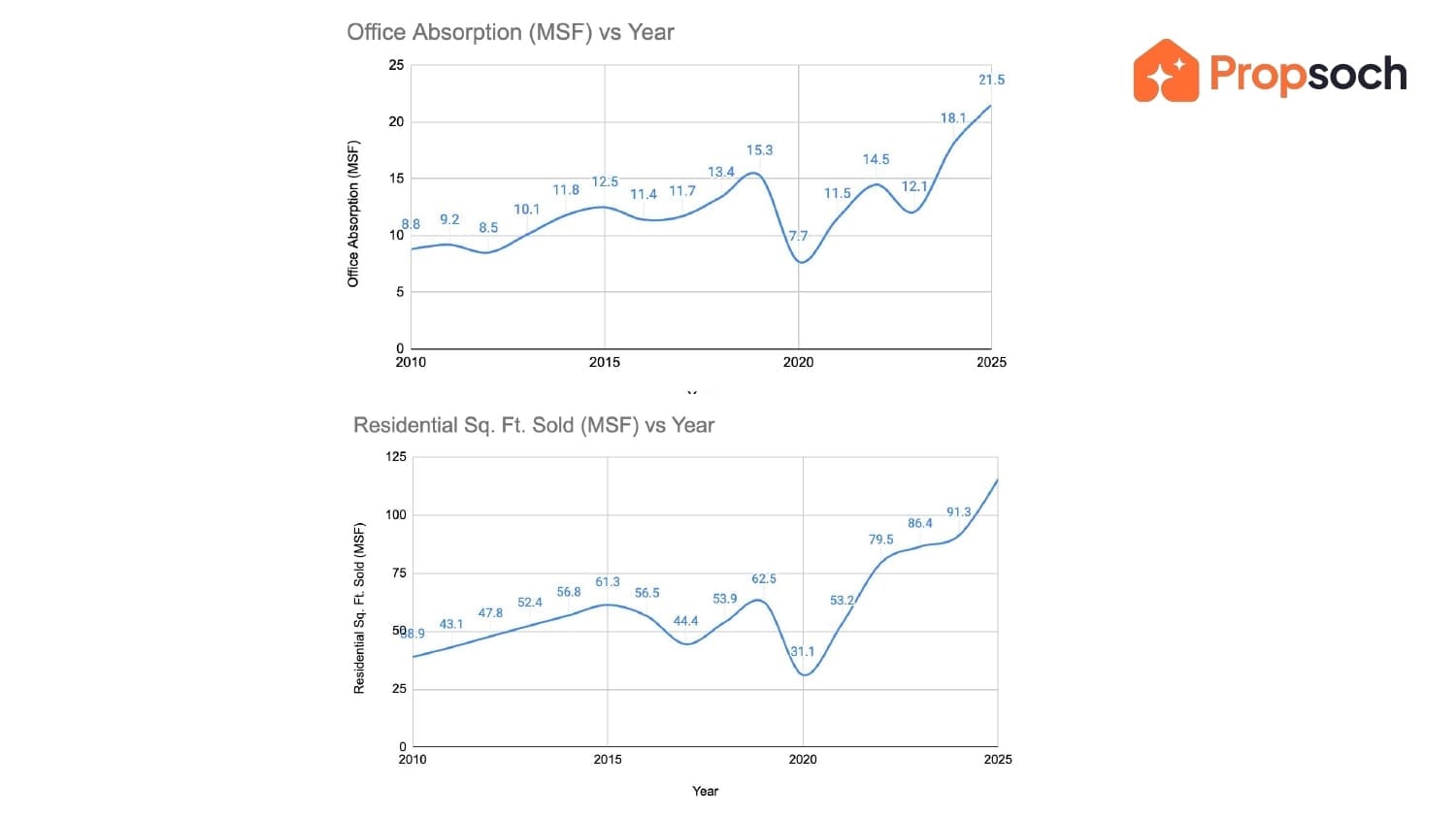
If you look at this chart, you will find that residential real estate closely coincides with office space leasings, and on average, every square foot of office space generates 5-10x of residential demand.
We shortlisted five micromarkets by checking commercial leasing volume and employer concentration against our in-house micromarket CAGR model, so each entry on this list is backed by both office-side and residential-side data.
1. Sarjapur Road: The IT Growth Engine
Sarjapur Road's biggest advantage is that its residential demand is not tied to a single office park.
The corridor sits within reach of multiple major employment hubs, including Wipro's corporate campus, RGA Tech Park, Cessna Business Park and Embassy TechVillage.
It gives the area a broad tenant and end-user pool rather than relying on one employer or one development. This employment density is important for residential demand.
Professionals working across the Bellandur-ORR belt can choose Sarjapur Road for relatively better access to larger homes and established residential communities, and such families are also drawn by the corridor's concentration of schools and everyday social infrastructure.
Rental Yield: ~3.5-4%
Homes within commuting distance of the IT corridor see great rental yield and CAGR, and this combined appeal makes Sarjapur Road all the more attractive to real estate enthusiasts.
- End-users: The case is strongest if you work in the wider Southeast Bengaluru IT corridor and want access to schools, larger homes and an established residential ecosystem.
- Investors: For investors, it's more about sustained employment-driven demand and the corridor's ability to serve multiple office clusters than about chasing the highest immediate rental yield. However, Sarjapur Road is a long corridor, so connectivity, traffic congestion, project quality and proximity to employment hubs can materially change the investment case.
2. East Outer Ring Road: Bengaluru's Commercial Powerhouse
If the core thesis is that residential demand follows employment, East ORR is one of the clearest examples of it. This is where some of Bengaluru's largest office campuses are concentrated.
RMZ Ecoworld alone spans 7.5 million sq ft and has a community of around 65,000 people, while Embassy TechVillage spans more than 9 million sq ft and currently reports 48 occupiers with 96% occupancy, according to Embassy REIT's June 2026 data.
The significance for residential real estate is straightforward, wherein a dense concentration of high-paying jobs creates a large pool of people who need to live nearby. That supports both rental demand and resale liquidity, particularly for apartments that offer a practical commute to the office clusters.
Rental Yield: ~4.5-6%
The healthy rental yield is supported by the depth of the demand, as it's a corridor that draws employees from technology companies, GCCs and other large corporate occupiers.
The trade-off is that East ORR is already a mature, premium-priced market. A large part of its employment story is already reflected in property prices, which can limit the room for appreciation compared with less mature corridors.
- End-users: The biggest advantage is the ability to live close to one of Bengaluru’s largest employment clusters. If you or your household work along the East ORR corridor, buying here can reduce daily commute times and provide access to a well-established ecosystem of offices, housing, retail and social infrastructure.
- Investors: The depth of the employment ecosystem creates a strong base for rental demand. The trade-off is the relatively high entry price and the maturity of the market. Water availability, traffic congestion and the scope for future price appreciation need to be assessed alongside rental income when deciding whether a property makes sense for a longer holding period.
3. Whitefield: The Mature IT Hub
Whitefield showed us what happens when an IT ecosystem matures into a full-fledged residential market with employment, infrastructure and housing demand reinforcing each other over time.
ITPL anchors a decades-old employment base, while the wider Whitefield ecosystem now includes Prestige Tech Park, Bagmane Tech Gardens, Airbus's Titanium Tech Park campus and major technology and engineering occupiers.
The corridor is also attracting newer high-tech activity with Embassy Developments signing a ₹1,125 Cr transaction with Lam Research for approximately 25 acres within Embassy East Business Park.
That maturity changes the residential investment equation. Whitefield has a large existing tenant base, established schools, retail, healthcare and residential communities, which means buyers are in for what the market is today, unlike other markets where potential is hinged on future growth.
Rental yield: ~3.5-4.2%
The rental market benefits from the depth of the employment ecosystem, while the Purple Line has improved the area's public-transport connectivity. The emerging Blue Line adds another potential connectivity layer.
Whitefield's main limitation is supply. A significant amount of residential development has already taken place, meaning buyers should not assume that every new project automatically benefits from a scarcity premium. Project selection, developer quality, location and entry price matter considerably.
- End-users: Whitefield is one of the easier choices for someone looking for an established East Bengaluru ecosystem rather than buying into a developing corridor. You get access to employment, schools, retail, healthcare and metro connectivity within an already mature neighbourhood.
- Investors: The appeal for Whitefield is about buying the right asset in a deep, established rental market. Properties close to employment nodes and transit are likely to have a wider tenant pool.
4. Bellandur: The High-Growth Corridor
Bellandur sits almost directly inside Bengaluru's strongest concentration of technology employment. Embassy TechVillage and RMZ Ecoworld are both located here, creating an unusually concentrated office-to-residential relationship.
Embassy TechVillage alone currently reports 48 occupiers and 96% occupancy, while RMZ Ecoworld houses around 65,000 people across its 7.5 million sq ft campus.
That proximity matters because Bellandur's residential demand is driven by one of the simplest real estate equations wherein people want to live close to where they work.
The area therefore has a deep pool of professionals looking for rental housing, particularly in apartments that offer a short commute to the ORR office belt.
Rental yield: ~3.5-4.5%
The 12% realistic CAGR in our research reflects the combination of a very strong employment base, constrained location and continuing infrastructure investment.
The Blue Line metro will add another connectivity option for Bellandur and Kadubeesanahalli once operational.
But Bellandur also demonstrates why CAGR cannot be viewed in isolation. The same concentration that creates strong housing demand also creates liveability challenges like water availability, traffic congestion and broader infrastructure constraints.
- End-users: Bellandur makes the most sense for buyers whose daily lives are closely tied to the ORR employment corridor and who value commute time over having a quieter or less congested neighbourhood.
- Investors: The attraction is the depth of the tenant pool and the relatively high appreciation. But because the entry price is already high, the investment case depends heavily on buying the right project and maintaining a sufficiently long holding period.
5. Hebbal: The Scarcity Play
Hebbal's investment story is different from the East Bengaluru corridors.
Instead of being surrounded by a sprawling collection of newer residential developments, Hebbal benefits from a strategic location where several demand drivers intersect: Manyata Tech Park, the Outer Ring Road, Bellary Road and the airport corridor.
Manyata Tech Park provides the employment anchor. It has become a major North Bengaluru employment centre, supporting a large pool of IT and GCC professionals who form a natural tenant and end-user base for surrounding residential markets.
The second driver is connectivity. Hebbal is already an important road junction for North Bengaluru and the airport corridor, while the upcoming Blue Line adds a major public-transport connection toward the airport. This gives the locality a connectivity story that extends beyond Manyata itself.
Rental yield: ~3%
Hebbal isn't necessarily a high-rental-yield play. Even if there's strong tenant demand from Manyata Tech Park and the wider North Bengaluru employment ecosystem, the property price is high which causes the yield to appear lower.
However, its appeal is the combination of strong employment demand, strategic connectivity and a premium location where capital appreciation can matter more than immediate rental income.
Property prices that were around ₹2,000–3,000/sq ft in 2009 are now around ₹22,000/sq ft in 2026. Its price journey illustrates how much of the transformation has already happened.
Source: Bangalore Realtors Association
- End-user: Hebbal works particularly well for buyers who want access to Manyata Tech Park, North Bengaluru and the airport corridor without moving too far into newer peripheral markets.
- Investor: The thesis is primarily capital appreciation rather than rental yield. Land constraints, established infrastructure and the potential connectivity benefits of the Blue Line create a different growth profile from supply-heavy corridors.
The key here is entry price. Hebbal is no longer an undiscovered market, so investors need to distinguish between genuine scarcity value and simply paying a premium for an established address.
Which of These Should You Choose?
There’s no single micromarket that works for every buyer. The right choice depends on what you’re optimising for, whether it’s proximity to work, rental demand, long-term appreciation, established infrastructure, or the potential of an emerging growth corridor.
The key is to match the market’s underlying growth drivers with your own investment horizon and end-use needs.
Ideal for
- Buyers prioritising long-term appreciation over immediate rental income (Bellandur, Hebbal)
- Buyers wanting the most established social infrastructure alongside a strong employer base (Whitefield)
- Family buyers weighing schools and connectivity together (Sarjapur Road)
Not ideal for
- Buyers who want to avoid known water-stress or congestion risk (Skip East ORR, Sarjapur Road and Bellandur)
- Buyers optimising purely for rental yield over appreciation, since the highest-CAGR pockets on this list aren't automatically the highest-yield ones
Get in-depth analysis of these micromarkets with our market experts!
Does This List Have Any Limitations?
The numbers in this analysis are designed to give you a realistic view of how these micromarkets stack up but no single metric can capture the full investment story.
CAGR and rental yield are useful indicators, but they need to be read alongside factors such as infrastructure, liveability, supply and the strength of the underlying employment ecosystem.
Here are a few important limitations to keep in mind:
- CAGR: The figures represent realistic estimates based on our analysis rather than optimistic upside projections. Actual returns can vary depending on the property, entry price, market cycle and holding period.
- Rental yield: It’s not uniform across a locality. Unit type, size, floor, building age, project quality and exact location can all materially affect the rent a property commands.
- Liveability: Water supply risk, traffic congestion and the premium commanded by A-grade developers are real considerations in several of these corridors. They can affect your ownership experience and entry cost even when the broader micromarket is showing strong appreciation.
- Employment: A large employer base is an important demand driver, but it doesn't automatically mean a hub will continue expanding. It's worth checking whether major office developments are still actively leasing space, attracting new occupiers and adding employment or whether the existing ecosystem is already close to capacity.
Ultimately, these numbers are best used to narrow down the markets worth investigating. The next step is to look at the specific project, price and micro-location within that market (we can help you with that 👀).
Final Verdict
Strong forward CAGR paired with real, verifiable commercial leasing activity is a more reliable investment signal than CAGR or IT-corridor proximity alone.
All five micromarkets above clear that bar, but they aren't interchangeable. Bellandur and Hebbal lead on appreciation potential, Whitefield and Sarjapur Road offer more mature social infrastructure alongside solid growth, and rental yield moves in the opposite direction of appreciation in most of these corridors.
The right pick depends on whether you're optimising for capital growth or monthly rental income!
Bangalore IT Hub Micromarkets FAQs
Which Bengaluru micromarket has the highest realistic CAGR near an IT hub?
Bellandur and Hebbal both show a 12% realistic CAGR in our dataset, the highest among the five micromarkets covered here.
What is the rental yield near Bengaluru's IT corridors?
Rental yield in these corridors typically ranges from 3% to 6% depending on the specific micromarket, unit type and building age, with Whitefield and ORR-East pockets often at the higher end.
Is Outer Ring Road, East still worth investing in despite the water and traffic risk?
It remains the densest commercial leasing corridor in the city with strong CAGR, but buyers should weigh the water supply and congestion risk against their holding period before committing.
Does employer presence matter more than infrastructure for these micromarkets?
Both matter together. Infrastructure improves access, but sustained rental and resale demand depends on whether the employers in that corridor are actively leasing more space, not just present.