
A few weeks ago, our research desk was buried in spreadsheets, RERA filings, and satellite imagery. Today, a distilled version of that work ran under a headline in the Times of India
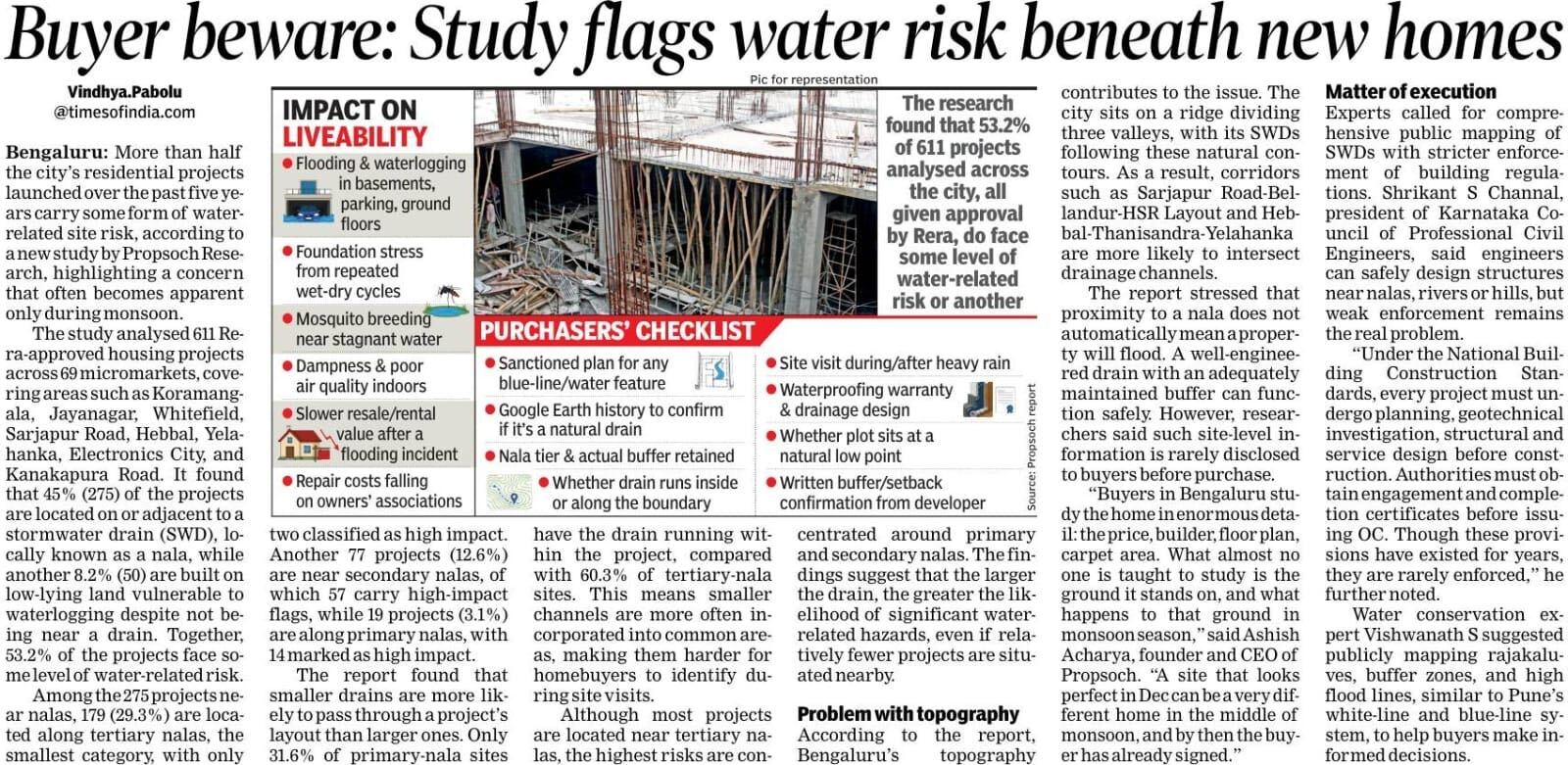
For a research-led advisory like Propsoch, this wasn't just a media mention. It was validation of an idea we've believed in since we started: that the biggest risks in a home purchase are often the ones nobody asks about.
Our research wing set out to answer a question that homebuyers in Bengaluru constantly worry about but don’t have the words for: what does the ground under a project actually do in the monsoon?
We analysed 611 RERA-approved housing projects spread across 69 micromarkets, including well-known corridors like Whitefield, Sarjapur Road, Hebbal, Yelahanka, Electronics City, and Kanakapura Road. The findings were sobering:
- 45% of projects (275) are located on or adjacent to a stormwater drain locally known as a nala.
- 8.2% (50 projects) sit on low-lying land vulnerable to waterlogging even though they aren't near a drain at all.
Put together, 53.2% of all 611 projects carry some level of water-related risk, despite every one of them having cleared RERA approval.
We classified nalas by tertiary, secondary, and primary because the size of the drain changes the nature of the risk.
Interestingly, smaller tertiary drains are the ones most likely to run directly through a project's layout, while the larger primary and secondary nalas carry a disproportionate share of high-impact flags even when fewer projects sit near them.
Behind the Scenes of this Research
This is the part that doesn't make it into a newspaper column, but it's the part we're proudest of.
Getting from "611 RERA filings" to "53.2% face some risk" meant going project by project. We cross-checked drain classifications, worked out actual buffer distances (not just sanctioned ones), and flagged whether the drain ran along a project's boundary or straight through it.
A lot of this data simply isn't centralised anywhere. There's no single map a researcher or a buyer can pull up to see where Bengaluru's rajakaluves run, how wide their buffers are supposed to be, or which of them have already been encroached upon.
So building this dataset meant assembling it drain by drain, project by project, layering RERA disclosures against terrain data and site history. It's tedious work. It's also exactly the kind of work that should exist before someone signs a nine-figure cheque for an apartment.
Why Does this Matter for Bengaluru Homebuyers?
Bengaluru's topography is working against it. The city sits on a ridge that splits into three valleys, and its stormwater drains simply follow those natural contours. That's why certain corridors Sarjapur Road-Bellandur-HSR Layout and Hebbal-Thanisandra-Yelahanka among them are structurally more likely to intersect a drainage channel than others.
To be clear, this isn't a case for panic. Being near a nala doesn't automatically doom a home to flooding a well-engineered drain with a properly maintained buffer can function safely for decades. The real problem is that this kind of site-level information is almost never disclosed to buyers before they sign.
As our Founder and CEO, Ashish Acharya, put it in the piece:
Bengaluru buyers study a home's price, builder, floor plan, and carpet area in painstaking detail, but almost no one is taught to study the ground the home stands on. A site that looks perfect in December can look completely different in the middle of monsoon, and by then, the sale is already done.
The story also brought in independent voices who reinforced this point. Shrikant S Channal of the Karnataka Council of Professional Civil Engineers noted that while engineers can safely design around nalas, rivers, or hills, weak enforcement of existing building standards is the real gap.
Water conservation expert Vishwanath S went further, calling for a public system that maps rajakaluves, buffers, and flood lines something like Pune's white-line and blue-line framework so that buyers aren't left guessing.
Is Your Homebuying Checklist Well Informed?
One of the most useful things to come out of this research is a simple checklist any Bengaluru homebuyer can actually use before signing:
- Ask for the sanctioned plan for any water feature near the site
- Confirm the nala's tier and the actual (not just sanctioned) buffer retained
- Find out whether the drain runs inside the plot or along its boundary
- Visit the site during or right after heavy rain, not just on a dry, sunny weekend
- Check whether the plot sits at a natural low point
- Get confirmation of the buffer or setback from the developer
Final Thoughts
Getting featured in the Times of India isn't the goal in itself it's a byproduct of the work. Propsoch was built on the idea that a home purchase decision deserves the same rigour as any other large financial decision, and that means going beyond price trends and possession dates into the physical realities of a site: its soil, its drainage, its history before it became a project.
This study is one example of that approach in practice, and we're glad a wider audience got to see the depth of work our research wing puts in behind every recommendation we make to a buyer.
If you're evaluating a home in Bengaluru and want a second opinion grounded in actual site research not just a sales pitch that's exactly what our team is here for.