“It’s close to the airport” sounds like a selling point until the first flight passes over your balcony at 2 a.m.
Airport proximity brings real upsides: faster access to flights, infrastructure investment and, in some pockets, rising prices. But it can also come with sound you can’t switch off.
Here’s what you can expect in this blog:
- How is airport noise measured?
- Kempegowda vs HAL: two very different noise profiles
- Micromarkets affected, and how they differ
- How noise affects liveability and resale value
- Are these airport-adjacent markets ideal for you?
How Airport Noise is Measured
Noise is measured in decibels (dB), and the scale is logarithmic. Every 10 dB increase is roughly perceived as a doubling of loudness, so a small number difference can mean a big difference at home.
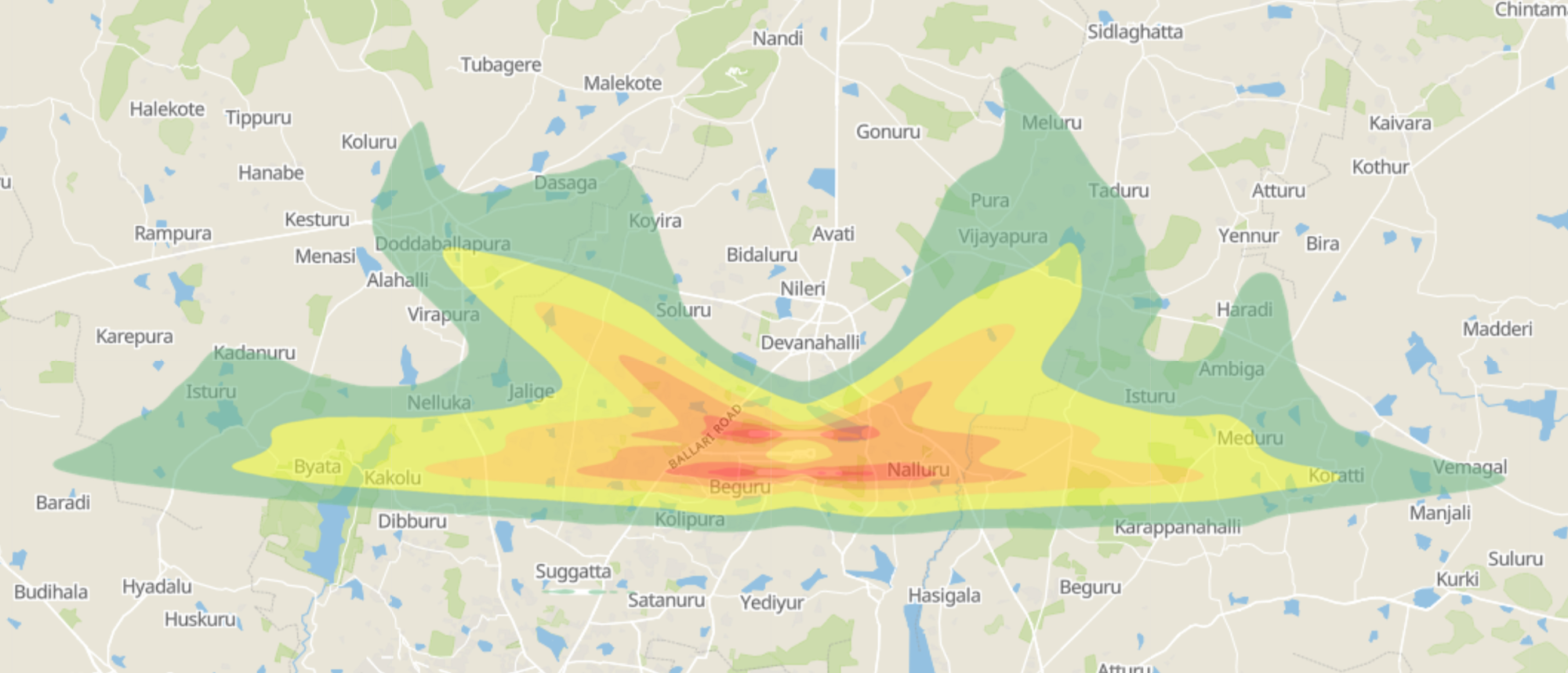
Noise Map is a tool that estimates flight noise from historical flight-position data and shows it as colour bands on a map. The tool uses a measure called Leq, the average sound level over time, and its estimates were within about 2 dB of sensor readings in the tool’s own evaluation.
How does this compare with the rules? India’s noise standards set a limit of:
- 55 dB by day
- 45 dB at night for residential areas
- 50 dB and 40 dB for silence zones
The WHO’s health-based guideline for aircraft noise is stricter: 45 dB by day and 40 dB at night.
Kempegowda vs HAL: Two Very Different Noise Profiles
Bengaluru’s two airports create noise in different ways, so the questions to ask differ too.
Kempegowda International Airport (Devanahalli)
KIA handles about 44.5 million passengers a year and takes all of the city’s scheduled commercial traffic. Its runways run east to west, so flight corridors extend along that axis. The noise is frequent and runs along fixed paths.
Distance from the runway ends and the flight corridor matters more than distance from the terminal.
HAL Airport (Old Airport Road)
HAL stopped commercial flights in May 2008, when KIA took over. It still sees regular movements: Air Force operations, charter and VIP flights.
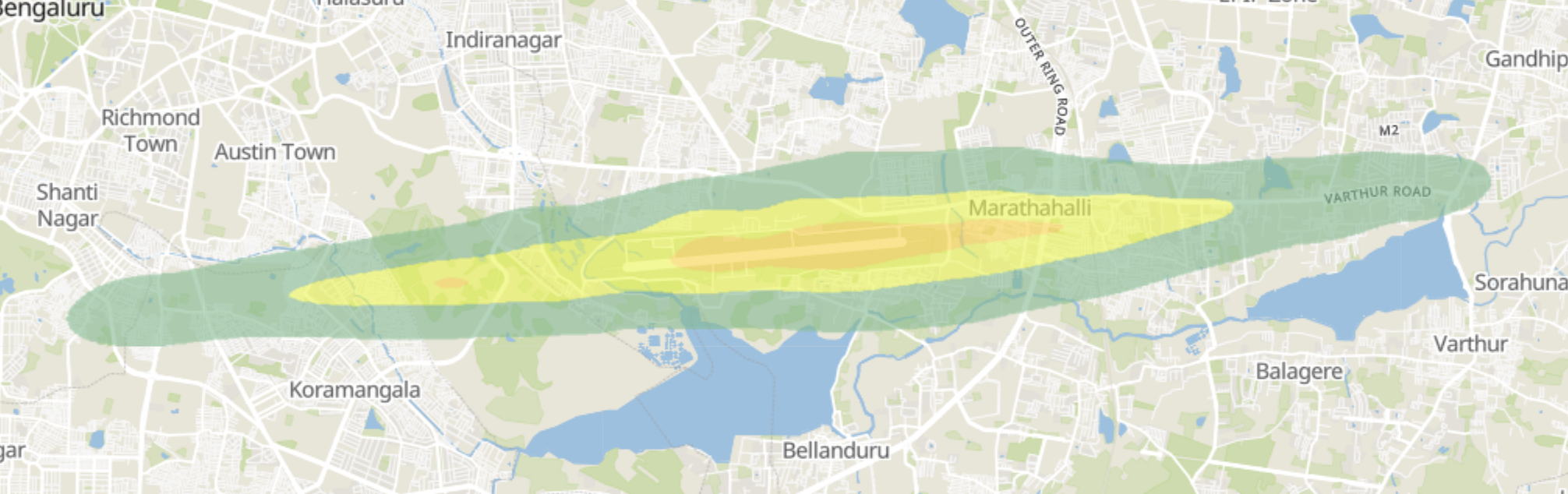
In 2023, residents reported low-altitude night-time pilot training by civilian airlines, which means noise at hours when people expect quiet.
When HAL’s Night Flights Woke Up Koramangala
In 2023, residents around the old HAL airport reported civilian pilot training flights at around 3,000 to 5,000 feet, beginning around midnight and running almost until daybreak. The reported path passed over Koramangala, HSR Layout, Sarjapur Road, Old Airport Road and Kaggadasapura.
Residents did not object to military operations. Their request was a quiet window between 10 pm and 6 am for civilian training. Readings taken by residents on handheld phones, which are approximate, showed more than 70 dB when aircraft passed directly overhead.
What it teaches buyers: The noise map shows an average, but the real question is when the noise happens. Perform a thorough evaluation by asking current residents.
Micromarkets Affected by Airport Noise
There are a lot of residential markets around the two Bengaluru airports. Here’s what you have to check when you’re exploring these markets:
How Airport Noise Affects Liveability
- Sleep: Night flyovers are the biggest issue. This is why the WHO’s night guideline for aircraft (40 dB) is lower than its day one.
- Daily comfort: Conversations, calls and working from home are affected in the loud bands (above 60 dB).
- Floor and orientation: Upper floors facing the flight path hear more than lower floors facing away.
- Windows and glazing: Acoustic glazing can reduce indoor noise, but you give up some of the open-window experience.
A buyer who works shifts or travels often may not mind what a light sleeper cannot live with. The right answer depends on you, not just the dB number.
Can Noise Affect Resale Value?
Devanahalli plot rates in 2026 are reported at ₹6,000 to ₹10,000 per sq ft, driven by airport expansion, SIR status and STRR connectivity.
So a noise discount or early-market disadvantages may be offset by the proximity premium. What it does mean is that noise-sensitive buyers, such as families with young children or senior residents, may be a smaller pool when you come to sell.
Which Buyers Should Consider Airport-Adjacent Homes?
Airport-adjacent properties may not be for everyone. It depends on the unique lifestyle choices that homebuyers may have. There are many upsides and downsides to such markets, and it boils down to a homebuyer’s non-negotiables and priorities.
Ideal for
- Frequent flyers who value a short airport commute
- Buyers who can accept a moderate noise band and mostly work outside the home
- Long-term investors backing the North Bengaluru growth story
Not ideal for
- Light sleepers or anyone with night-time sensitivity
- Buyers who work from home and need quiet
- Families with infants or senior citizens
Final Verdict
Airport proximity is a trade-off, and noise is the part most buyers never check. The good news is that it is measurable. A few minutes with our experts and some questions to residents tell you more than any brochure.
Such data protects your liveability, informs your resale expectations and gives you a stronger hand in negotiation. If you’re weighing a home near KIA or HAL and want a second pair of eyes on it, our market experts are here to help!
Airport Noise and Affected Properties in Bengaluru FAQs
How noisy is it near Kempegowda International Airport?
It depends on your position relative to the runway axis and flight corridors. Our experts can help you see the estimated noise for any address, and visit at different times of day.
Do flights still operate from HAL Airport?
Not scheduled commercial flights, which moved to KIA in May 2008. HAL still sees Air Force operations, charter and VIP flights, and residents have reported civilian night-time pilot training.
What is the permissible noise level in a residential area in India?
55 dB during the day and 45 dB at night, as per the Noise Pollution (Regulation and Control) Rules.
Does airport noise reduce property prices?
Studies in countries like USA and China find about 0.6 to 1.0% lower prices per extra decibel. No Bengaluru-specific study confirms this, and on the contrary, proximity to the airport can raise demand, especially due to planned infrastructure and early-market advantage.
Can I use noise data to negotiate the price of a home?
A higher noise band than comparable projects, along with a narrower resale pool, can act as a fair basis for negotiation or for mitigation like acoustic glazing.