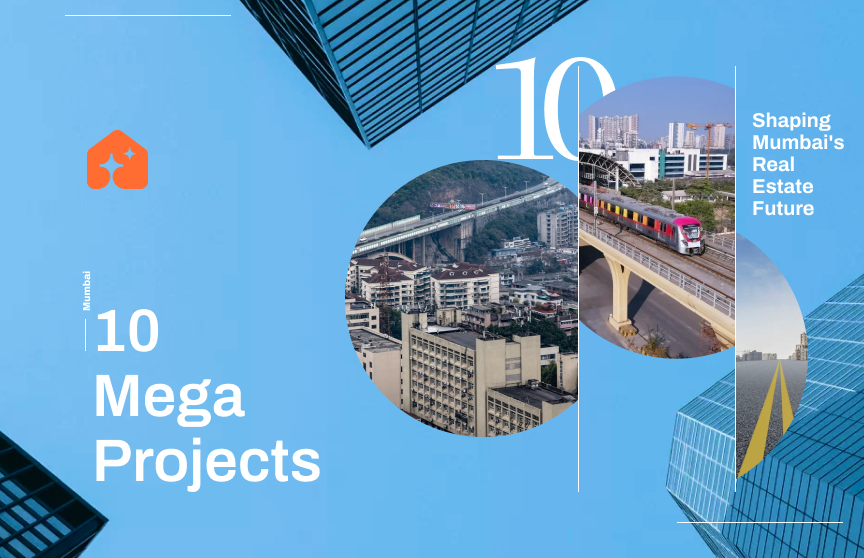
Mumbai is in the middle of its most ambitious infrastructure rollout in decades and Mumbai real estate is about to undergo a huge shift because of these 10 mega projects.
From twin tunnels beneath the Sanjay Gandhi National Park to sea links stitching together the coastline and pod taxis across the BKC, these projects are rewiring the city's commute map and creating ripples in Mumbai real estate with it.
Here are the projects we cover in this blog:
- Mumbai Metro Lines Expansion (6, 2B, 4)
- Goregaon-Mulund Link Road
- Sewri-Worli Elevated Connector
- Versova-Bandra-Bhayandar Sea Link
- Thane-Borivali Twin Tunnel
- BKC Pod Taxis
- Orange Gate Tunnel
Mumbai Metro Lines Expansion
Perhaps one of the most convenient modes of transportation for newcomers to the city, there are quite a few metro lines set for expansion.
Metro Line 6: Lokhandwala - Vikhroli
Expected to be completed in 2026, Metro Line 6 finally threads the needle between Mumbai's western and eastern suburbs. It runs along the Jogeshwari-Vikhroli Link Road (JVLR) a corridor that has long been a pinch point for anyone crossing the city's midsection.
Real Estate Impact: For real estate, this is a major catalyst for Lokhandwala, Powai, and Kanjurmarg. Powai's business park, already a magnet for tech companies, becomes significantly more accessible for professionals living on the western side of the city.
Shorter commutes mean more potential residents, driving up both residential demand and property values along the corridor.
Source: MMRDA
Metro Line 2B: DN Nagar - Mandale
Line 2B runs parallel to SV Road and the Western Express Highway, two of Mumbai's most traffic-choked arteries between Borivali and Bandra.
By offering a reliable metro alternative along this corridor, it promises to significantly ease the daily commute for hundreds of thousands of western suburb residents heading to BKC and beyond.
Real Estate Impact: The Andheri-Bandra belt is where most of the value appreciation is expected. Better connectivity to BKC, Mumbai's dominant commercial district, alongside a genuine improvement in road congestion makes this stretch considerably more liveable. That livability premium tends to get priced in quickly.
Source: MMRDA
Metro Line 4: Wadala - Ghatkopar - Thane
Metro Line 4 bridges South Mumbai's Wadala with Thane district, passing through Ghatkopar along the way. It stitches together traffic-prone areas like LBS road junction in Ghatkopar, LBS road Powai junction, Mulund LBS road, Teen Hath Naka and Ghodbunder Road flyover.
Real Estate Impact: Thane and Ghatkopar stand to gain the most. Both areas have seen sustained interest from homebuyers, but commute reliability has always been a sticking point. As that barrier lowers, residential prices in these nodes, already on an upward trajectory, are expected to continue climbing.
For Thane in particular, better metro access deepens its case as a self-contained satellite city.
Source: MMRDA
Are you curious as to how a property in these affected areas can appreciate in value? We can help you navigate your homebuying decisions accordingly!
Sewri-Worli Elevated Connector
Expected by 2027, this elevated road is a missing link in Mumbai's coastal road network, connecting the Mumbai Trans Harbour Sea Link (MTHL)/Atal Setu at Sewri to the Bandra-Worli Sea Link.
Once complete, it creates a continuous high-speed corridor that ties together Navi Mumbai, South Mumbai, and the Western Suburbs without touching the congested road grid.
Real Estate Impact: Premium localities like Worli, Prabhadevi, and Dadar gain direct, seamless connectivity to Navi Mumbai's corporate campuses, their airport and the western suburbs' residential neighbourhoods.
For a stretch that already commands some of Mumbai's highest property values, enhanced accessibility from multiple directions only reinforces the premium.
Source: News18
Versova-Bandra-Bhayandar Sea Link: Coastal Road Phase 2
It is a multi-phase coastal sea link that stretches the city's waterfront road network northward. The first phase connects Versova to Bandra and subsequent phases extend toward Bhayandar, eventually creating a near-continuous coastal bypass for the western suburbs.
Phase 1 (expected by 2028) alone will dramatically cut travel times from Versova and Andheri to Bandra's commercial hubs, putting upward pressure on property values in Andheri and Versova.
Real Estate Impact: The longer-term extension to Bhayandar is arguably more transformative as it reframes Mira Road and Bhayandar as viable, affordable alternatives for city-based professionals who consider the commute to be chaotic today.
Source: Hindustan Times
Goregaon-Mulund Link Road (GMLR)
Expected to be completed in 2026, the GMLR creates a new east-west spine for the city, giving drivers a much-needed alternative to the perennially congested Western Express Highway and Eastern Freeway. It directly connects Goregaon in the west to Mulund in the east.
Real Estate Impact: Mulund, Goregaon, and Powai are all set to benefit from faster cross-city connectivity. For buyers and renters who work on one side of the city but prefer or pricing of the other, the GMLR makes such trade-offs far more manageable.
Source: BMC
Thane-Borivali Twin Tunnel
The Thane-Borivali tunnel is a twin road tunnel bored directly through the Sanjay Gandhi National Park, creating a straight-line connection between Thane and Borivali. These are two major urban nodes currently separated by a circuitous route on Ghodbunder Road that is regularly prone to traffic.
The transformation is stark: a journey that can take over two hours in peak traffic is reduced to approximately 15 minutes. This fundamentally changes Thane's value proposition.
Real Estate Impact: For homebuyers employed in the western suburbs, Thane offers larger homes at significantly lower price/sq ft. and it becomes a genuinely attractive primary residence rather than a compromise. New residential supply will follow demand into Thane's peripheral areas.
This project is also a huge feat for India’s infrastructure story as it made news for being India’s largest 13.34m single shield Tunnel Boring Machine (TBM).
Source: MMRDA
Orange Gate Tunnel
With underground road connectivity from Eastern Freeway at Orange Gate to Marine Drive, Orange Gate Tunnel is a ₹8,056Cr project that aims to meet the growing demand in that area, especially to Navi Mumbai International Airport.
It is a 9.96-km twin tunnel project planned to be a key East-West connector in South Mumbai. During peak hours, the 5km stretch from Eastern Freeway to South Mumbai takes around 25-30 minutes, which by 2028, is projected to only take around 5 minutes.
Real Estate Impact: With slashed commute times, this project will boost connectivity and appreciation across South Mumbai. The improved connectivity to Navi Mumbai Airport will also be a strong anchor point for increased value.
Source: The Indian Express
BKC Pod Taxis
It is an 8.85-km long pod system with a ₹1017Cr budget that acts as an alternative to buses, carrying six passengers at a time in individual pods spread across the Bandra-Kurla Complex (BKC) to improve connectivity across transit hubs and business centres.
The arrangement is on a public-private partnership (PPP) basis, with the Mumbai Metropolitan Region Development Authority (MMRDA) as the nodal agency, and they’re planning for 38 pod stations across BKC.
While Phase 1 can be expected by 2027, completion is stretched as far as 2041. In recent news, the Maharashtra government is keen on expanding the system to Thane and Mira-Bhayandar.
Source: The Times of India, The New Indian Express
Final Thoughts
Taken individually, each of these projects solves a specific bottleneck. Taken together, they amount to a fundamental reordering of Mumbai's connectivity story, which also contributes significantly to Mumbai real estate.
The city is expanding its effective radius, places that once sat at an impractical distance from commercial centres are being drawn closer.
For buyers watching the market, the question is increasingly not just where a neighbourhood sits today, but where it sits in relation to tomorrow's infrastructure map. Mumbai homebuyers have already begun this calculation, as its going to be a strong anchor for price appreciation and value.
For more guidance on how infrastructure updates will affect your homebuying decisions, reach out to us and we can provide you with the information you need to get your dream home.